
2026 US PGA Golf – Trading Preview
The second major championship of the year heads to one of America’s great classic venues in 2026, as the PGA Championship arrives at the famous Aronimink Golf Club.
While much of the focus will naturally fall on the world’s best players, the course itself could become the real star of the week.
Aronimink is not a regular stop on the PGA Tour, which creates uncertainty for both punters and traders. Unlike Augusta or Sawgrass, there is far less recent form to rely on, and that often leads to fascinating market behaviour.
The venue has only hosted three modern PGA Tour events that offer meaningful comparison data:
- 2010 AT&T National
- 2011 AT&T National
- 2018 BMW Championship
That relatively small sample makes this championship particularly interesting from a betting and trading perspective.
Aronimink Looks Built For Major Championship Drama
The official 2026 setup measures a demanding par 70 stretching to 7394 yards.
At first glance that sounds intimidating, but the numbers underneath reveal something more subtle.
Aronimink is not simply about brute force. It creates constant swings between opportunity and danger. Players can make birdies quickly, but they can also destroy a scorecard within a few holes.
That sort of volatility is ideal for exchange trading.
The course contains several genuine scoring holes, most notably the par-5 16th, which historically played nearly half a shot under par during previous PGA Tour visits. Birdies and even eagles are common there.
But Aronimink also contains some brutal momentum killers.
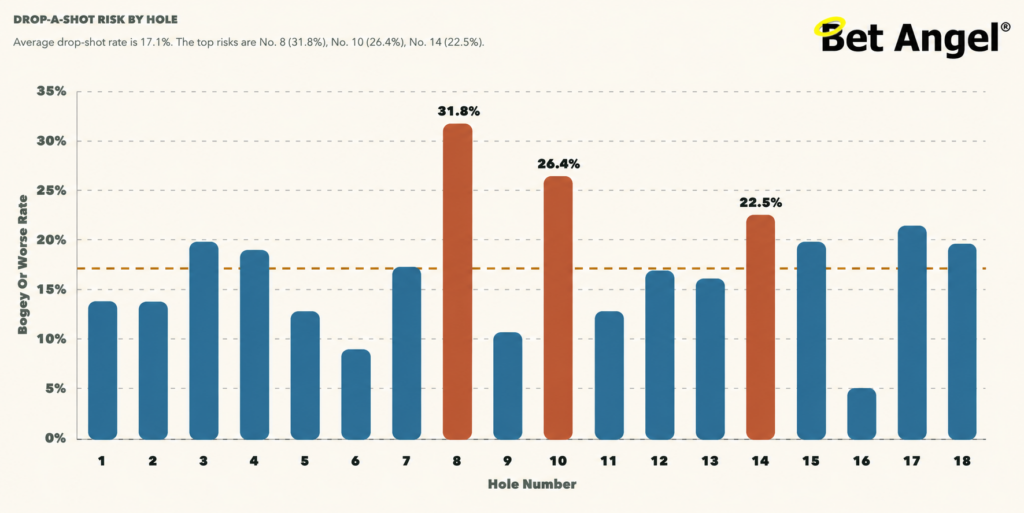
The par-3 8th has historically been one of the toughest holes on the course, averaging almost 0.3 shots over par with a bogey-or-worse rate approaching 32%.
That creates exactly the sort of late-round volatility traders love.
The Closing Stretch Could Be Crucial
One of the most fascinating aspects of Aronimink is the balance between attackable holes and survival holes late in the round.
The par-5 16th offers a huge scoring opportunity. Historical data shows nearly half the field made birdie or better there during previous events.
But immediately after that comes the difficult par-3 17th and a demanding closing par-4 18th.
That combination could create dramatic leaderboard swings on Sunday afternoon.
A player standing on the 16th tee with a one shot lead may suddenly face:
- A realistic eagle opportunity
- A difficult par-3 under pressure
- A demanding finishing hole
Markets tend to overreact massively during those moments.
One aggressive play on 16 could shorten a player dramatically. One poor swing on 17 or 18 could send their price drifting instantly.
That is exactly why major championship golf often produces outstanding trading opportunities.
This Is Not Purely A Bombers Course
Although Aronimink is long by modern standards, the data suggests the course rewards precision and discipline just as much as power.
Several holes historically played tougher than their yardage suggests:
- Hole 10 averaged +0.230 over par
- Hole 15 averaged +0.124 over par
- Hole 14 averaged +0.132 over par
These are the types of holes where players can quietly lose tournaments.
That is important because betting markets often focus too heavily on headline names and driving distance statistics.
In reality, major championships are frequently won by players who avoid mistakes rather than simply overpowering the golf course.
Aronimink Encourages Comebacks
One particularly interesting aspect of the historical data is how difficult it has been for leaders to dominate from start to finish.
In the three modern PGA Tour events at Aronimink:
- No first round leader converted into victory
- Two of the three winners were at least three shots behind after round two
- Only one winner led outright after 54 holes
That suggests Aronimink naturally compresses the field.
Mistakes are always possible, and momentum can change rapidly.
For traders, that is hugely important.
It means there may be value opposing short priced leaders, especially before the closing stretch.
Weather Could Change Everything
As always in major championships, setup and weather will play a huge role.
If conditions become soft, the longer hitters may gain a stronger advantage. But if the PGA of America manages to firm up the greens and increase rough penalties, Aronimink could become a brutal positional test.
That uncertainty itself creates opportunity.
Golf markets often struggle to fully price changing conditions during a tournament.
Final Thoughts
The 2026 USPGA Championship looks perfectly set up to become a classic major.
The course itself may ultimately shape the championship more than any individual player.
Aronimink combines risk, reward and pressure in a way that should produce constant leaderboard movement across all four days.
For punters, the challenge will be identifying players capable of surviving the difficult stretches while still taking advantage of the scoring opportunities.
Because this course is played in frequently, I have no confidence about how exactly I’m going to trade it. I’m going to have to watch the first round very carefully and see if that matches some of the historical data that I’ve gathered. If it does, then I’ll gain a bit more confidence over the remaining days. This is a little bit more of a challenge than traditional major golf courses for me because of the lack of data.
However, the combination of major championship pressure and Aronimink’s volatile layout should create exactly the type of market movement that experienced exchange traders look for.