
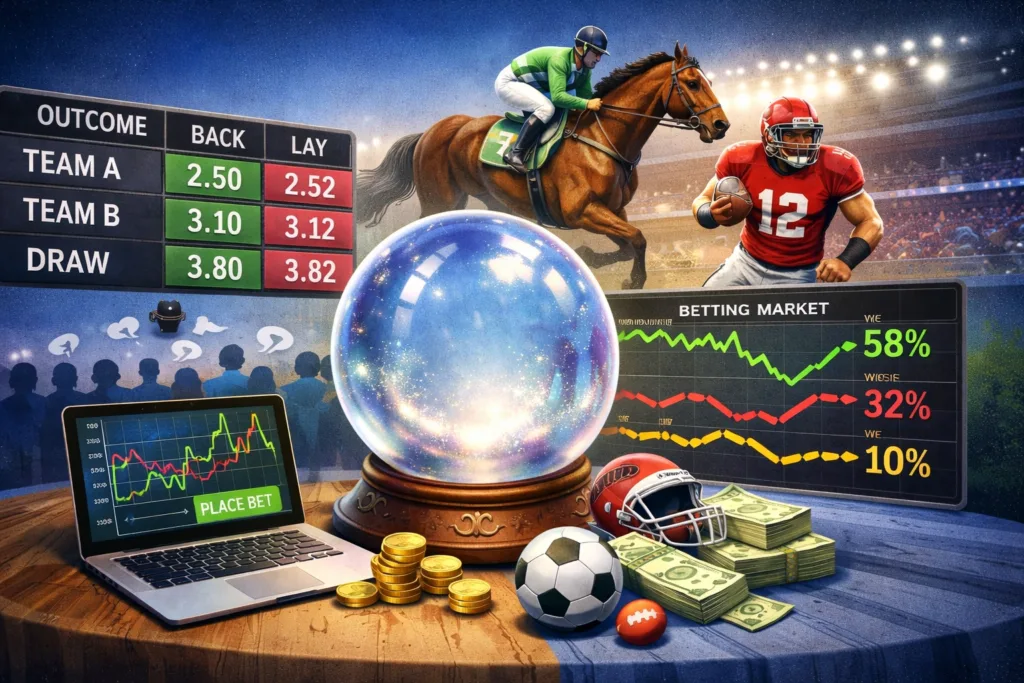
Predictions Markets?
Yes, we’ve known about those for 20 years!
In recent months there has been a surge of interest in prediction markets. Silicon Valley startups, financial commentators and economists are suddenly fascinated by the idea that markets can be used to forecast the future.
Polymarket and Kalshi often hit the headlines, sometimes for the wrong reasons, for some market or another.
The concept is simple: if you allow people to trade on the outcome of events, the resulting prices reflect the collective expectations of the crowd. Markets become a mechanism for aggregating information.
But there’s something slightly ironic about the excitement surrounding prediction markets.
Betting exchanges have been at the forefront for decades.
Betting Exchanges Are Real Prediction Markets
Every afternoon somewhere in the world, thousands of people interact in betting exchanges to form prices on the outcome of a sport. Participants bring different opinions, models, information and insights to the market. As money flows through the exchange, prices adjust continuously to reflect the balance of those views.
In effect, what emerges is a real-time probability forecast.
The odds you see on a betting exchange are not simply numbers. They represent the aggregated judgement of a large and diverse group of participants. New information is quickly absorbed and reflected in the price.
From a market perspective, betting exchanges behave remarkably like prediction markets.
Cheltenham: One of the Most Liquid Prediction Markets in the World
The Cheltenham Festival is a fascinating example of this process in action.
For a few days each year, the markets around Cheltenham become some of the most liquid betting markets anywhere in the world. Huge volumes of money interact with a vast range of opinions, data and analysis.
Prices move instantly as new information arrives. Traders react to shifts in sentiment, news, paddock observations and statistical models.
If someone were asked to design a real-world prediction market from scratch, it would look remarkably similar to a betting exchange during the Cheltenham Festival.
The Racing Industry’s Missed Opportunity
Despite this, the racing industry rarely talks about these betting markets in these terms.
Yet racing already sits on top of one of the most sophisticated forecasting systems ever created.
And the opportunity extends far beyond the markets themselves.
Modern horse racing generates an extraordinary amount of data. Today many races include GPS tracking data that records the precise position and movement of every horse throughout the race.
That data has enormous potential.
Imagine watching a race with real-time positioning, pace analysis and evolving probability estimates as the race unfolds. For younger audiences raised on live statistics, gaming environments and interactive sports coverage, this type of data layer could make racing dramatically more engaging.
The sport already has the raw material to create a far richer and more interactive experience.
Yet the predictive power of the markets and the analytical richness of the data are rarely explored or promoted in a meaningful way.
A Conversation the Industry Rarely Has
Each year around Cheltenham I write to various racing commentators and industry “experts” asking if they would like to explore the story behind how these markets actually work.
Over the years I’ve managed to win on every race at the Cheltenham Festival more than once. That isn’t because I possess some mystical insight into horse racing. It’s because these markets are incredibly efficient information systems. When you understand how they operate, you are essentially interacting with a constantly evolving forecast produced by the crowd.
More often than not, I never hear back.
That’s always surprising, particularly at a time when racing frequently discusses the challenge of attracting younger audiences and developing new revenue streams.
When a sport already sits on top of one of the most sophisticated real-time prediction systems in existence, ignoring that story feels like a significant missed opportunity.
Prediction Markets Are Suddenly Fashionable
Prediction markets may be fashionable today.
Technology companies and economists are exploring how markets can be used to forecast elections, economic outcomes and real-world events.
But the basic principle has already been operating quietly for many years.
Every afternoon, betting exchanges aggregate information, opinions and expectations into prices that represent a constantly evolving forecast of what might happen next.
And for a few days each year, the Cheltenham Festival becomes one of the most compelling examples of that process anywhere in the world.
Horse racing may not always describe it this way.
But the sport has been running prediction markets for a very long time.