
Aftertimers of the world, unite!
It’s the time of year when I’m quite likely to pick off some huge trades.
The funny thing is I can’t tell you where it’s going to occur. I’ll be looking for it and I’ll be ready for it, but I can’t tell you specifically what race or on what runner it’s going to happen.
This weekend I’ll be going for a large total on the Grand National. Again, before I start trading, I have no idea what I’m going to do. I’ve got some strategies and tactics that I’m likely to use if I see certain things, but I don’t know what they will be until I start trading.
I’ll post my Grand National result on Saturday night, and a bit later, I’ll tell you how much money I’ve made at the US Masters by the cut.
Again, all of these things I can’t tell you what’s going to happen in advance, but I can tell you things that will allow you to anticipate and profit from what could happen.
The problem I have is when I post up these results, is that I’m almost inevitably going to get accused of after-timing, so I had to write about it.
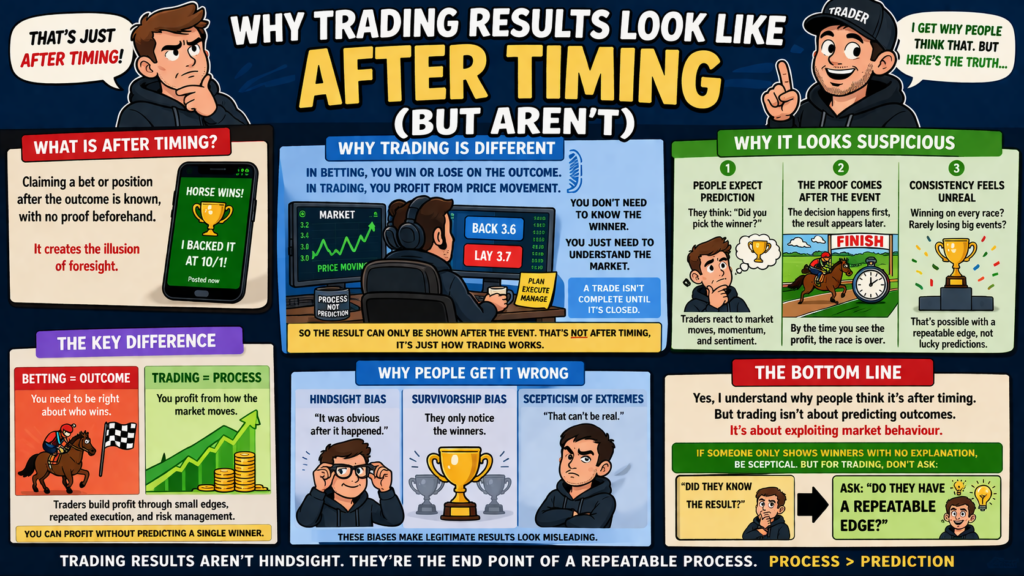
What After Timing Actually Means
After timing is simple:
Claiming a bet or position after the outcome is known, without any prior evidence.
It’s about creating the illusion of foresight.
So scepticism around it is justified.
Why Trading Doesn’t Fit That Definition
In betting, you win or lose based on the outcome. In trading, you profit from price movement.
That means:
- You don’t need to know the winner
- You don’t need to predict the result
- You just need to understand how the market behaves
Most importantly:
A trade isn’t complete until it’s closed. So the result can only be shown after the event.
That’s not after timing — it’s just how trading works.
Why It Looks Suspicious
Even when everything is genuine, trading results can look exactly like after timing from the outside.
Here’s why.
1. People Expect Prediction
Most people view everything through a betting lens:
- “Did you pick the winner?”
- “Did you know what was going to happen?”
But traders aren’t predicting outcomes.
They’re reacting to:
- Market moves
- Momentum
- Changes in sentiment
You can profit on a race and still have no idea which horse will win. Or, for that matter, care!
2. The Proof Comes After the Event
In trading:
- The decision happens first
- The result appears later
By the time you show a profit:
- The race is over
- The outcome is known
So it looks like hindsight — even when it isn’t.
3. Consistency Feels Unreal
When you hear things like:
- Winning on every race Race at Cheltenham
- Never having lost at the Derby
- Only ever having one losing year at the US Masters Golf
- Rarely losing on big events etc.
…it sounds utterly implausible.
But that reaction comes from betting logic. A bettor needs to be right about outcomes. A trader needs a repeatable edge.
That’s a completely different game.
The Key Difference
Here’s the simplest way to frame it:
- Betting = outcome
- Trading = process
A trader builds profit through:
- Small edges
- Repeated execution
- Managing risk
Over time, that can produce very consistent results — without predicting a single winner.
The Bottom Line
I completely understand why people think trading results are after timing.
From the outside, they look similar:
- Results shown after the event
- Strong consistency
- Clear profits
But the reality is very different.
Trading isn’t about predicting outcomes.
It’s about exploiting market behaviour.
And you can only demonstrate that once the trade is complete. I’ve now been doing this for over twenty years. It’s been twenty-six years since I opened my Betfair account. I’m very consistent now, I’m literally a machine!
Your experience or that of others may not be so consistent, but it’s just something that’s borne out by experience.
Final Thought
If someone only shows winning bets with no explanation, be sceptical.
But when it comes to trading, don’t ask:
“Did they know the result?”
Ask:
“Do they have a repeatable edge? I wonder what they’re doing.”
Because that’s where the truth actually lies.