
The 2026 Open Championship
The Open Championship returns to Royal Birkdale in 2026 for the eleventh time, bringing one of the fairest but most demanding links courses back into focus.
While the layout has seen several important changes since Jordan Spieth lifted the Claret Jug in 2017, history still provides plenty of clues about how this championship is likely to unfold.
For traders and bettors, understanding how Royal Birkdale rewards good play and punishes mistakes can provide valuable opportunities throughout the week.
A True Championship Test
Royal Birkdale has always been regarded as one of the fairest venues on the Open rota.
Unlike some links courses where fortunate bounces can heavily influence scoring, Birkdale generally rewards players who consistently hit fairways and control their ball flight.
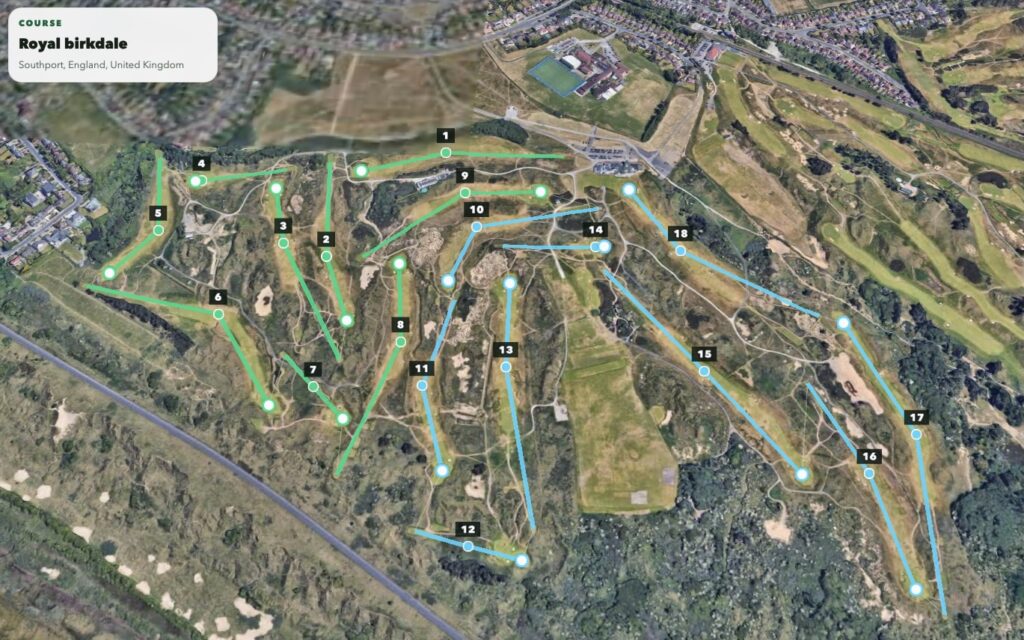
The 2026 course will measure 7,223 yards and play to a par of 70, although several holes have been redesigned since the last Open here. Holes 5, 7, 14, 15 and 18 have all undergone significant changes, meaning historical scoring should be treated as a guide rather than an exact prediction.
That said, the overall character of Royal Birkdale remains the same.
Players still need to drive the ball accurately between towering dunes before attacking relatively small greens protected by deep bunkers.
Expect Difficult Scoring If The Wind Arrives
One striking feature of previous Opens at Royal Birkdale is just how dramatically scoring varies depending on the weather.
In 1998 and 2008, the field averaged over four shots above par per round.
By comparison, Jordan Spieth’s victory in calmer conditions during 2017 saw the field average only around one shot over par.
That makes Royal Birkdale particularly sensitive to wind forecasts.
A seemingly modest increase in wind speed can quickly transform the course from a venue where players attack pins into one where simply making par becomes an achievement.
For in play traders, monitoring changing weather conditions during the championship could become one of the biggest sources of value.
Saturday Position Matters
One of the strongest historical patterns concerns where eventual winners sit entering the final round.
Every modern Open winner at Royal Birkdale has been within two shots of the lead after 54 holes.
Three of the last five winners actually led or shared the lead after Saturday.
Even when players have recovered from slow starts, they have generally needed to work themselves into contention before Sunday begins.
This is useful when evaluating players during the tournament. While early comebacks are certainly possible after Thursday or Friday, history suggests that players several shots adrift heading into the final round have very little chance of lifting the Claret Jug.
The Toughest Stretch
Historical hole by hole data highlights where Royal Birkdale traditionally creates separation.
The old sixth hole stands out as the most demanding on the course, averaging over half a stroke above par across recent Opens.
More than half of all players dropped at least one shot there.
Several other holes consistently produced high bogey rates, particularly those playing into the prevailing wind.
These holes often become pivotal during difficult weather conditions.
Rather than producing spectacular birdies, they gradually wear players down through steady accumulation of bogeys. That creates excellent opportunities for in play trading, particularly when leaders approach these stretches late in their rounds.
Where Players Can Attack
Despite its reputation, Royal Birkdale does contain scoring opportunities.
Historically, the par fives have offered the clearest birdie chances. The old 17th hole was comfortably the easiest on the course, producing birdies or better over 40% of the time.
The former 15th also played under par.
Although the routing has changed slightly for 2026, these remain the sections where momentum can build quickly. Players reaching these holes in good conditions may create significant movement on the leaderboard.
Accuracy Beats Power
Royal Birkdale has crowned some of golf’s greatest champions.
Tom Watson, Ian Baker Finch, Padraig Harrington and Jordan Spieth all demonstrated similar qualities despite very different playing styles.
None relied purely on power.
Instead they excelled through:
- Accurate driving
- Excellent long iron play
- Strong scrambling
- Patience in difficult conditions
- Avoiding costly mistakes
This is often overlooked in modern golf, where driving distance dominates discussion. At Royal Birkdale, controlling the golf ball remains considerably more important than simply hitting it as far as possible.
Watch The Weather More Than The Leaderboard
The Open Championship is unique because weather conditions can completely alter the competitive landscape. Morning and afternoon draws can differ dramatically.
Wind direction may change several times during the day.
A player appearing safely in control can suddenly find themselves battling to save par over the closing stretch.
For traders, reacting to changing course conditions often proves more profitable than reacting to the leaderboard alone.
Betting Implications
Royal Birkdale tends to reward disciplined golfers rather than streaky scorers. When assessing players throughout the week, keep an eye on:
- Players hitting a high percentage of fairways.
- Strong scrambling statistics.
- Ball striking rather than putting alone.
- Competitors within two shots after 54 holes.
- Wind forecasts for every round.
- Performance through the toughest middle section of the course.
Final Thoughts
Although Royal Birkdale has undergone several changes since 2017, its identity remains unmistakable.
It is still one of the purest tests in championship golf.
History shows that patience, accuracy and intelligent course management consistently outperform aggression.
If the weather becomes challenging, expect scoring to rise quickly, leaderboards to compress and opportunities for in play traders to increase throughout the championship.
As always with The Open, the weather forecast may ultimately prove just as important as the players themselves.