
The Paper That Changed Everything
For most people, statistics are the starting point when trying to beat a market.
For me, they were only ever part of the picture.
After spending years trading betting markets, I kept seeing the same strange patterns over and over again. Markets would move in ways that didn’t seem entirely rational. People would make decisions that looked obviously wrong. Prices would overshoot, drift too far, or stubbornly refuse to move despite overwhelming evidence.
At first, I assumed I simply hadn’t found the right statistical model. Then I discovered the work of Daniel Kahneman and Amos Tversky.
Reading their paper on Prospect Theory completely changed how I approached markets.
Instead of asking:
“What does the data say should happen?”
I started asking:
“Where are people most likely to make mistakes?”
That single change in perspective transformed how I viewed ALL markets.
The problem with assuming people are rational
Classical economics assumes that people are rational decision makers.
If presented with two choices, they should simply choose whichever has the highest expected value.
But anyone who has spent time watching financial markets, Betfair, horse racing, football or almost any competitive environment quickly realises that people don’t actually behave that way.
- They overreact.
- They panic.
- They become greedy.
- They hate admitting they’re wrong.
- They cling to losing positions while cashing out winning ones far too early.
The numbers often weren’t wrong. The people were.
The birth of Prospect Theory
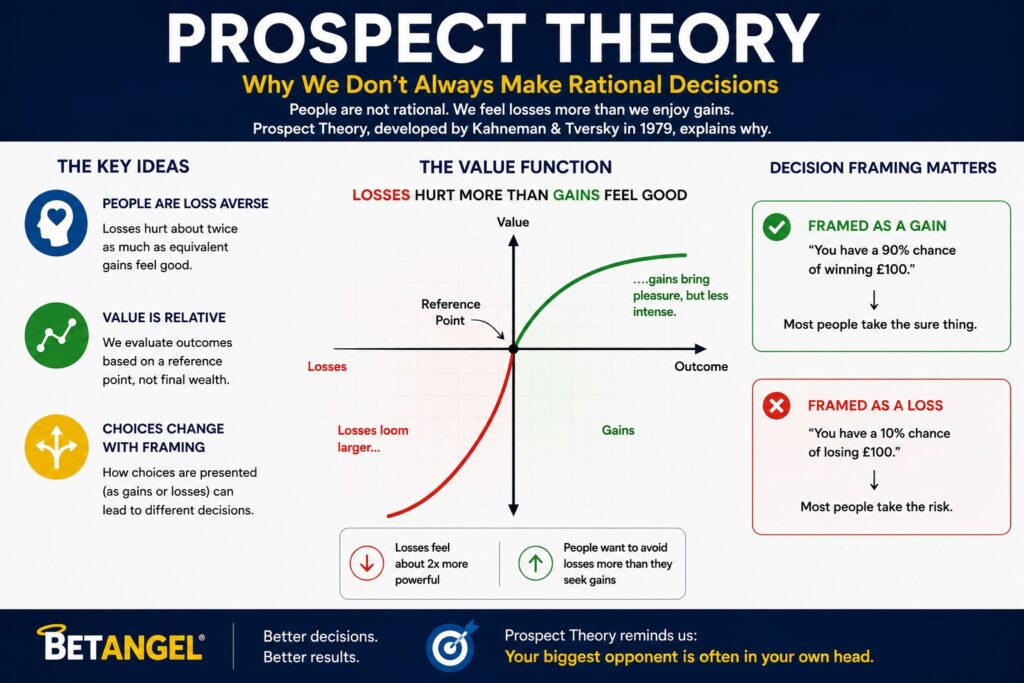
In 1979, psychologists Daniel Kahneman and Amos Tversky published a paper called Prospect Theory: An Analysis of Decision Under Risk.
It would become one of the most influential papers ever written in behavioural economics. Their work challenged the long held assumption that humans make logical decisions. Instead, they demonstrated that our choices are heavily influenced by psychology.
People don’t simply maximise expected returns. They evaluate gains and losses emotionally. That sounds obvious today, but at the time it fundamentally challenged decades of economic thinking. The impact was enormous.
Kahneman later received the 2002 Nobel Prize in Economic Sciences for this work (Tversky had sadly passed away before the prize was awarded, and Nobel Prizes are not awarded posthumously).
Losses hurt more than gains feel good
Perhaps the most famous finding from Prospect Theory is something known as loss aversion.
Losing £100 hurts considerably more than gaining £100 feels good.
In fact, numerous experiments suggest the emotional pain of losing is roughly twice as powerful as the pleasure of an equivalent gain. Once you understand this, many betting markets suddenly begin to make sense.
We don’t think in absolute terms
Another key insight is that people evaluate outcomes relative to a reference point.
Winning £500 after expecting to win £1,000 feels disappointing.
Winning £500 after expecting nothing feels fantastic.
The amount hasn’t changed. Only the expectation has. Betting markets constantly establish these reference points.
A favourite drifting from 2.0 to 2.6 suddenly feels weak, even if nothing fundamental has changed. An outsider shortening from 20.0 to 12.0 suddenly feels attractive because everyone anchors themselves to the earlier price.
Again, psychology influences prices just as much as information.
The certainty effect
Prospect Theory also showed that people consistently overvalue certainty. They’ll often accept a guaranteed smaller reward instead of a larger reward with only slightly more risk.
This is something I saw countless times in markets. Traders would green up for tiny profits despite having a statistically excellent position.
Not because it was mathematically optimal. Because certainty feels comfortable. The guaranteed win removes emotional stress.
Why this changed everything for me
Before discovering Prospect Theory, I spent a lot of time looking for statistical anomalies. The six years or so were purely statistical.
I analysed thousands of markets. Built databases. Tested systems. Measured everything I could.
Statistics remain incredibly important.
But Prospect Theory gave me something statistics couldn’t. It explained why those anomalies existed in the first place. Instead of simply identifying an edge, I started asking where human psychology was likely to create one.
That became a much more productive question. People are predictable in surprisingly irrational ways.
Looking for mistakes instead of answers
This became one of the biggest changes in my thinking.
Rather than trying to predict everything correctly, I became interested in predicting where everyone else would be wrong. That’s a subtle but powerful distinction.
Markets don’t have to be perfectly predictable. People don’t have to make huge mistakes. You only need enough participants to consistently behave in predictable psychological ways.
If enough people fear losses more than they value gains…
If enough people panic…
If enough people anchor to previous prices…
Then opportunities inevitably appear.
Final thoughts
One academic paper won’t suddenly make you a profitable trader.
But Prospect Theory fundamentally changed the questions I asked. I stopped searching exclusively for statistical relationships. Instead, I started looking for situations where human beings were likely to misjudge risk, overreact emotionally or make consistently irrational decisions.
That shift in thinking has influenced almost every strategy I’ve developed since.
Markets aren’t just collections of numbers. They’re collections of people.
And people, as Kahneman and Tversky brilliantly demonstrated, don’t always behave the way traditional theory says they should.