
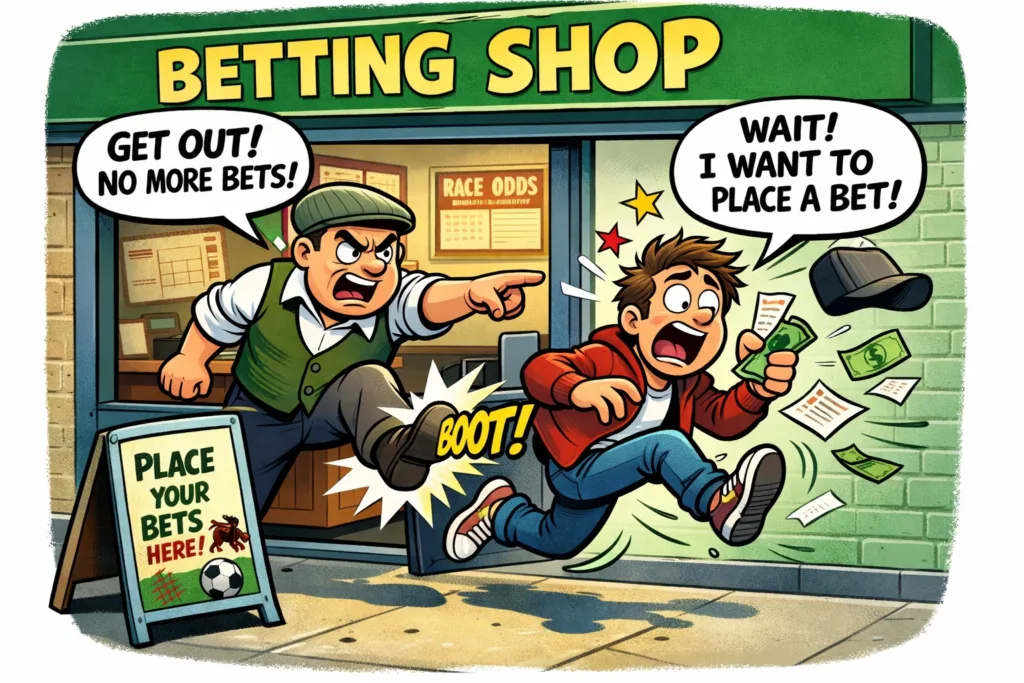
The Battle to Stop Clever People Betting
In December’s Christmas special, The Economist published a long and revealing piece titled “The battle to stop clever people betting”, examining how modern bookmakers identify, restrict, and exclude successful customers.
For anyone who has spent serious time betting or trading, the article reads less like investigative journalism and more like confirmation of a reality that has existed for years.
What makes the article particularly striking is not just what it says, but how openly it says it.
Below is a structured review of the article, with regular quotations and commentary, followed by an angle that The Economist only hints at, but never fully explores: why betting exchanges exist, and why they are the best place to bet if you actually know what you are doing.
What the article gets absolutely right
Early on, the article cuts straight to the core issue:
“Sports-betting firms don’t. Indeed, they dislike winners so much that they deploy complex tools to stop them from wagering more than a pittance.”
That single sentence undermines the entire public-facing narrative of the betting industry. Bookmakers advertise excitement, skill, and knowledge, yet internally treat those very traits as liabilities.
The article explains how “sharps” – skilled bettors – are routinely subjected to stake restrictions, sometimes before they have even had a chance to prove long-term profitability:
“For skilled players, or ‘sharps’, such ‘stake restrictions’ are common.”
That is not an exaggeration. In practice, profiling begins from the first bet, not the hundredth.
Profiling before you even know it’s happening
One of the more telling lines appears near the end of the piece:
“The profiling process starts before you place a bet.”
This matters enormously. Many casual bettors assume restrictions only arrive after sustained winning. In reality, the industry has become exceptionally good at predicting who is likely to win before it happens.
Market selection, timing, bet type, device, payment method and even withdrawal behaviour are all used to assess whether you are a long-term liability.
The myth that “only a tiny percentage are restricted”
Bookmakers frequently claim that restrictions affect only a tiny minority. The article challenges this politely, but firmly:
“Most punters are unaware that betting firms, whose adverts promise glittering riches, are at pains to shut out winners.”
It cites Gambling Commission data showing that 4.3% of active UK accounts have stake factors applied. Across millions of accounts, that represents a huge number of customers being quietly managed out of the market.
And crucially, those customers are not being restricted because they are dangerous, but because they are competent.
Whales, sharps, and deliberate confusion
One of the strongest sections explains how bookmakers simultaneously chase losers while suppressing winners:
“At the same time, they want to hook big losers, or ‘whales’… However, some ‘whales’ are sharps in disguise.”
This contradiction sits at the heart of bookmaker risk management. Size alone is not welcomed. Only losing size is.
The DraftKings anecdote included in the article neatly exposes how superficial VIP treatment really is. The moment skill is detected, limits collapse.
Beards, mules, and predictable consequences
The article then moves into territory rarely discussed openly in mainstream media:
“An alternative is to get someone else, known as a ‘beard’ or ‘mule’, to bet on your behalf.”
This is not criminal ingenuity. It is market adaptation.
When legitimate winning is not tolerated, workarounds become inevitable. The article correctly presents this as a symptom of the system, not the cause.
My perspective: why betting exchanges solved this problem
Where The Economist stops short is in fully explaining why betting exchanges exist, and why they are, by a long distance, the best place to bet if you understand what you are doing.
Betting exchanges operate on a fundamentally different model.
They do not set prices.
They do not build in a margin via a spread.
They do not care who wins.
Instead, they charge commission on net winnings.
That single structural difference changes everything.
On an exchange, winners are not a threat. They are a revenue source. If you win, the exchange gets paid. If you lose, the exchange still gets paid. There is no incentive to profile, restrict, or exclude skill.
That is why individuals have bet billions on exchanges, and why a significant amount of money has been won, not just staked.
Commission versus spread: the difference most people never grasp
Traditional bookmakers make money by being wrong less often than you. Their edge is embedded in the price.
Betting exchanges make money by facilitating liquidity. Their edge is transparent and fixed.
This leads to better prices, genuine market efficiency, and no conflict between bettor and platform.
Once you understand this, the entire bookmaker model starts to look outdated.
Why exchanges rarely get mentioned in articles like this
The uncomfortable truth is that betting exchanges expose the bookmaker model for what it really is.
If betting were truly about skill, price and judgement, exchanges would dominate the conversation. Instead, most public debate focuses on restriction, protection and control, because that is where bookmaker incentives lie.
Exchanges quietly demonstrate that betting can function as a fair marketplace, provided the operator is not betting against its own customers.
Final thoughts
The Economist deserves credit for documenting the reality of modern bookmaker behaviour. But the real conclusion sits just beyond the article itself.
The battle to stop clever people betting only exists where clever betting threatens the business model.
On betting exchanges, that battle simply does not need to be fought.
And that is precisely why, for anyone serious about betting, trading, or consistently getting good prices, exchanges are not just an alternative.
They are the inevitable destination.