
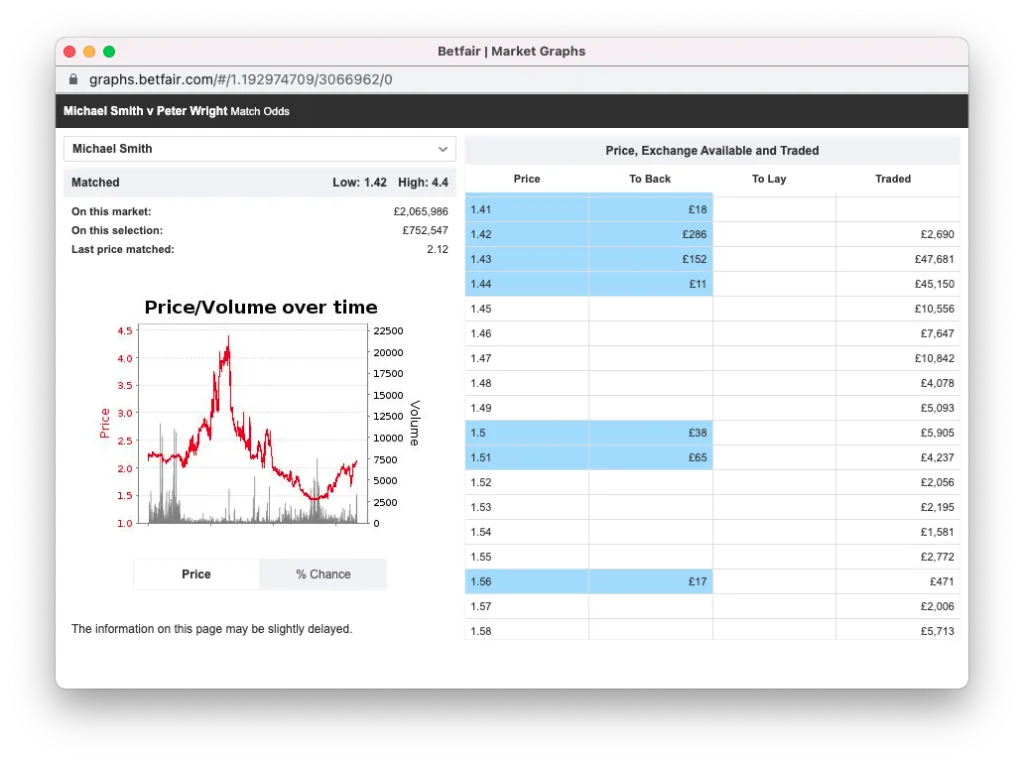
Trading Darts is the New Tennis Trading
If you’ve spent time trading on Betfair, you’ll know that each sport has its own rhythm — football has momentum swings, horse racing has pace and position, and tennis has its serve and break points.
But one of the more surprising parallels lies between darts and tennis. On the surface, they’re worlds apart — one’s played in a quiet arena with chalkboards and tungsten, the other on court under the roar of a crowd — yet from a trading perspective, they share remarkably similar dynamics.
Let’s break down why that is and how you can use this knowledge to your advantage.
Scoring Structure and Market Flow
In both darts and tennis, the scoring format creates clear, repeatable trading cycles.
- In tennis, players hold serve until one manages to break.
- In darts, players hold throw until one manages to break.
This structure means each leg or game is like a micro-battle — and the market prices adjust accordingly after every throw or point. Traders look for opportunities where the probability of a break is mispriced, especially when the underdog applies pressure.
That similarity in structure gives both markets a predictable ebb and flow that traders can anticipate. You can often sense when a player is about to be broken — not by guessing, but by reading the tempo, composure, and pressure moments just as you would in tennis.
Momentum and Psychology
Momentum is everything in both sports.
A player missing a double in darts can feel just as pivotal as a player double-faulting at break point in tennis. Both events shift confidence, crowd energy, and odds movement.
Because of this, psychology plays an enormous part. Traders who can read body language, rhythm, or composure can get ahead of the market.
- When a tennis player’s serve starts to wobble, the odds move sharply.
- When a darts player starts pulling darts or dropping low, the same thing happens.
Momentum trading in these markets rewards those who recognise when the tide is turning — often before the scoreline fully reflects it.
Instant Price Feedback
Unlike football, where markets can drift slowly between goals, tennis and darts prices update with each point or throw.
This rapid feedback gives traders more data and more entry points. Every leg or game becomes a trading opportunity.
That means you can enter and exit frequently, locking in small profits without waiting for a final result — just as you would when trading service games in tennis. The fast cycle of scoring also makes both markets ideal for automation strategies or in-play models based on momentum and probability.
Pressure Points Define Value
In both sports, not all moments are equal.
Break points in tennis and double attempts in darts are the moments of truth.
Markets tend to overreact to pressure situations. A missed double or a saved break point can cause wild swings in price, which are often temporary. Skilled traders learn to fade those overreactions and trade back towards equilibrium once the emotion settles.
This ability to identify overreaction and correction is what separates trading from punting — and both tennis and darts provide countless examples every session.
Consistent Player Match-Ups
Both sports feature head-to-head contests between individuals, not teams.
That means form, temperament, and playing style are easy to analyse — and consistent over time.
If a tennis player struggles on return, or a darts player cracks under finishing pressure, those traits tend to persist. You can build data-driven models or profiles for each competitor and use that information to shape your in-play expectations.
This consistency makes both highly data-friendly markets — perfect for traders who like to combine statistical preparation with real-time observation.
Final Thoughts
Trading darts on Betfair feels different in atmosphere but not in logic.
Like tennis, it’s about momentum, holding serve (or throw), identifying break points, and staying calm under pressure.
If you’ve mastered tennis trading, you already understand much of what drives the darts market — you just need to adjust for the rhythm and style of play.
Conversely, if you’re comfortable with darts, tennis trading will feel like a natural extension of the same principles.
Both reward patience, discipline, and timing — and both can deliver excellent trading opportunities for those who understand how psychology and probability intertwine in a one-on-one contest.