
The surprising maths behind 60 years of hurt
If you’ve ever wondered how likely a football team is to win a World Cup, how often a trader should expect to have a winning day, or how many successful bets you might achieve over a season, then you’ve already encountered a problem that can be solved using the binomial distribution.
The phrase sounds intimidating, but the idea behind it is surprisingly simple.
The binomial distribution is one of the oldest and most useful concepts in probability. It allows us to answer a straightforward question:
How likely am I to achieve a certain number of successes if I repeat the same experiment many times?
Whether you’re tossing a coin, trading on Betfair, investing in financial markets or analysing football tournaments, the same mathematical principles apply.
The Origins of the Binomial Distribution
The story begins in the seventeenth century.
At the time, gambling was hugely popular across Europe. Wealthy individuals frequently played games involving dice, cards and wagers, and many disputes arose over how winnings should be shared when games ended unexpectedly.
In 1654, two French mathematicians, Blaise Pascal and Pierre de Fermat, exchanged a series of letters discussing these problems. Their work laid the foundations of modern probability theory.
Several decades later, Swiss mathematician Jacob Bernoulli expanded on these ideas in his book Ars Conjectandi, published in 1713. Bernoulli studied repeated experiments with only two possible outcomes:
Success or failure.
Win or lose.
Heads or tails.
He discovered a pattern governing the number of successes that occur over repeated trials. This pattern became known as the binomial distribution.
More importantly, Bernoulli showed that over time, observed results tend to converge towards the true underlying probability. This became known as the Law of Large Numbers and remains one of the most important concepts in statistics.
Understanding the Basic Idea
Imagine tossing a fair coin. Each toss has:
50% chance of heads.
50% chance of tails.
If you toss the coin once, the possible outcomes are obvious. But what if you toss it ten times?
How likely are you to get:
Exactly 5 heads? Exactly 7 heads? Exactly 10 heads?
The binomial distribution answers all of these questions. It tells us the probability of obtaining any number of successes over a fixed number of attempts. The same principle applies far beyond coins.
A trader may have a strategy that wins 55% of the time.
A football team might have a 10% chance of winning a tournament.
An insurance company may estimate a 2% chance of a particular claim occurring.
All of these situations can be analysed using the same mathematical framework.
A World Cup Example
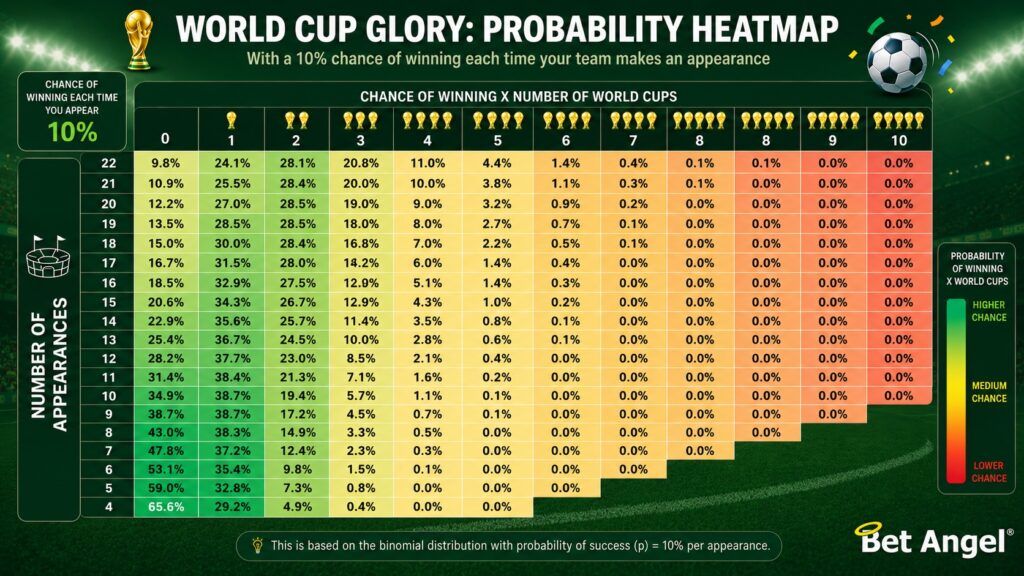
England has entered 16 World Cups. Suppose their chance of winning each tournament is 10%.
Most people instinctively think: “A ten percent chance isn’t very much.” They’re right when considering a single tournament.
However, the picture changes dramatically when we consider repeated opportunities.
The chance of not winning a single World Cup is: 0.9 × 0.9 × 0.9 × … repeated sixteen times. This gives: 18.5%. Therefore the chance of winning at least one World Cup becomes: 81.5%.
If we flip the calculation around to ask ‘What is the chance of England winning X World Cups’ we also see the highest peak at one world cup win in 16 tournaments. About a 33% chance, though there was also a 27% chance we should have won two.
This result often surprises people. A relatively modest chance repeated enough times can become a very strong chance of eventual success. But also the chance of converting that into a small number of tournament wins is quite small.
Since 1966 England have competed in 14 tournaments, meaning one win stands at 35.6%. More importantly, the chance of any win at a 10% chance per tournament is 77%. Sort of expected mathematically, if not by the Nation.
Why This Matters for Betting
The binomial distribution provides an important lesson for bettors and traders. Many people evaluate strategies using small sample sizes. A trader might experience:
Five losing days in a row.
Ten winning trades in succession.
A month of disappointing results.
These events can feel significant. However, if the strategy genuinely has a positive edge, short-term outcomes can easily differ from long-term expectations.This is exactly what the binomial distribution predicts.
Suppose a trader has a strategy with a 55% strike rate. Over ten trades, almost anything can happen. Over one thousand trades, results begin to resemble the underlying probability.
This is why professional traders focus on large samples rather than individual outcomes.
The Hidden Mathematics Behind Casinos
Casinos are perhaps the best real world example of binomial thinking. They know perfectly well that individual customers may win. Some customers will enjoy extraordinary luck. Others will suffer unusually poor runs.
However, when millions of bets are placed, the casino’s mathematical edge emerges. The short term becomes noisy. The long term becomes predictable.
Insurance companies operate in much the same way. So do market makers, bookmakers and many financial institutions.
Final Thoughts
One of the reasons the binomial distribution remains so powerful is that it bridges the gap between probability and reality.
Most people understand the idea of a chance. Far fewer understand how repeated chances accumulate over time. The binomial distribution gives us a framework for answering those questions.
It explains why casinos make money, why traders trust large sample sizes, why sports teams sometimes underperform expectations.
For something developed more than three centuries ago, it remains one of the most practical tools available for understanding uncertainty.